


Why Final
Why Final.
Voices and instruments sound real. The loudspeakers disappear and the musicians are with you in the room.
Explore01 / What you hear
Closer to the performance.
The breath before a phrase, a finger sliding along a guitar string, the air between the instruments: all of it is there. Voices and instruments sound real. The loudspeakers disappear and the musicians are with you in the room. Nothing added. Nothing lost.
“Final Electrostatic speakers are a special breed, even among electrostatics.”
“In a living room you therefore have the illusion of being present at a live performance.”
02 / What Final does differently
Six differences,
in plain words.
Every electrostatic loudspeaker moves the air with a thin film. This is what Final does differently from most electrostatic loudspeakers.
- 01
The film keeps its sound for decades.
Final uses a film that is stronger, stiffer and more heat resistant than the film in almost every other electrostatic loudspeaker, so it keeps its tension, and its sound, for decades. Its conductive layer absorbs no moisture: the sound is the same in a humid summer as in a dry winter.
- 02
Flat stators that do not rust.
Final makes its stators perfectly flat, so the film is pushed and pulled with the same force over its whole surface, for lower distortion. They are made of acrylic in the Configure range and of glass-fibre epoxy in the Ready to Play range. Neither can rust or corrode, and the conductive tracks sit on the side facing the film, so there is no metal under voltage on the outside of the panel.
- 03
Treble and bass from one film.
Voices and instruments come from one surface, without a transition. The frequency division is printed into the stator itself. The full-range models of the Configure range need no woofer at all. Where a subwoofer is added, it takes over at 150 Hz or lower, at the very bottom of the voice range. Curved hybrid panels usually hand over at 250 to 400 Hz, in the middle of it.
- 04
An ordinary amplifier is enough.
Many electrostatic loudspeakers need large, very stable power amplifiers. A Final has a sensitivity of 88 dB and a nominal impedance of 4 Ω: a good amplifier of 50 to 150 W is enough, and modern class D amplifiers drive it without difficulty.
- 05
60 to 100 cm from the wall is enough.
Like every panel that plays to the front and the back, a Final needs some space behind it, but 60 to 100 cm from the back wall is enough and the side walls may be close. Two people can easily carry a pair.
- 06
The smaller models hang on the wall.
The panels of the Final 1300, Final 1500 and Final 1700 can hang on the wall like a painting, as the Final 1310, Final 1510 and Final 1710.
Every Final is built by hand in the Netherlands, where the company was founded in 1989.
03 / How it works
Final Wavefield™
Technology.
A thin, charged film sits between two perforated stators. The music signal changes the electric field between the stators; the field moves the film, and the film moves the air.

Look a little closer
Together.
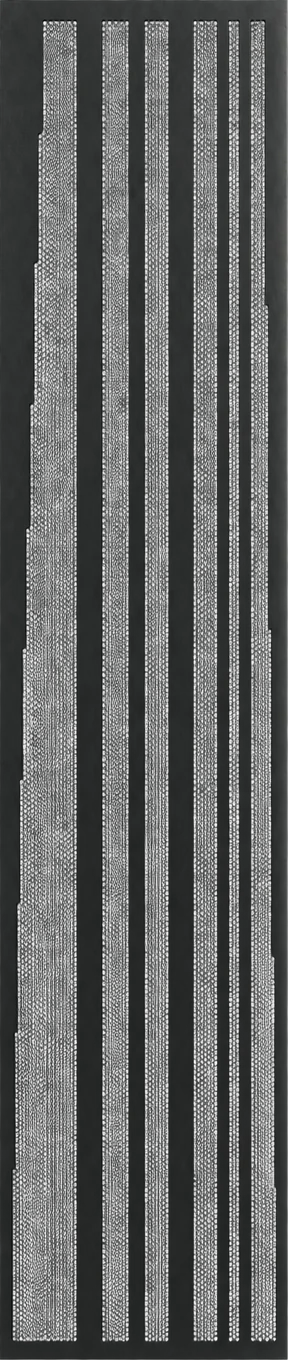
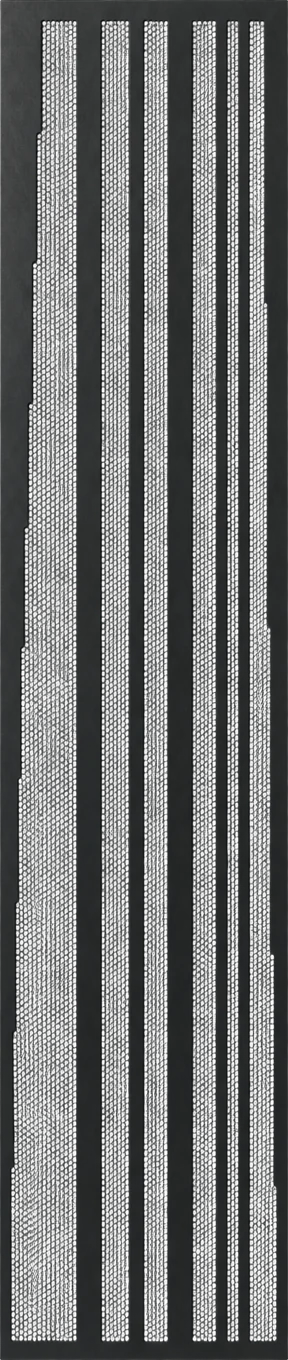
Two perforated stators sit either side of an ultra-thin film. With no cabinet around it, the open panel radiates to the front and the rear, and voices and instruments keep their natural character.
The stators.
The music signal drives the two stators. They are perfectly flat, so the gap to the film is the same everywhere and the film is moved with the same force over its whole surface, rather than pushed from a single point. They are made of acrylic in the Configure range and of glass-fibre epoxy in the Ready to Play range, with the conductive tracks on the side facing the film.
The film.
An exceptionally light film is the only moving part. It starts and stops with the music, so the beginning of a note and the smallest detail remain intact.
The printed filter.
The conductive pattern on the stator is divided into tall strips of different widths. Low notes use the whole width of the panel; as the notes rise, the sound narrows to the slimmest strips. Each strip filters itself, so there is no crossover network of coils and capacitors between your amplifier and the film, and the slim treble strips spread the high notes across the room, whether you sit or stand.
Principle illustrated. Layers and spacing enlarged.
Two ways to move air
The difference
begins inside.
Both conventional and electrostatic loudspeakers turn an electrical signal into moving air. They take very different routes to get there.
Five ways to move air
Not every panel
works the same way.
Electrostatic and planar loudspeakers all move the air with a light film. How they drive that film decides how they sound, how they age and how easily they live with your amplifier and your room.
A curved panel.
Some electrostatic panels are curved to spread the treble. A curve means the gap between film and stator cannot be the same everywhere, and a curved panel cannot play low enough on its own: it usually hands over to a woofer at 250 to 400 Hz, in the middle of the human voice. Final keeps its panels flat, spreads the treble with slim strips, and plays down to 150 Hz from even the smallest panel, so the voice stays on the film.
Rings and a delay line.
Other full-range panels divide the film into rings fed through a delay line of coils and capacitors. That adds a network of parts to the signal path, and such panels are often large and heavy. Final prints the division into the stator: one capacitor, no delay line, and full range from a slim panel.
Planar magnetic.
Planar magnetic loudspeakers move the film with rows of magnets and an aluminium conductor glued onto it. The magnetic field is not equally strong across the film, the glue can let go after many years, and with an efficiency of around 80 to 83 dB they often need 300 W or more. A Final is driven by an even electric field, its conductor is deposited rather than glued, and a good amplifier of 50 to 150 W is enough.
Metal stators.
Many electrostatic panels use perforated metal stators. Metal can corrode and rings like metal, and the tiny burrs left by punching the holes are where a spark can start. Final’s stators are not metal: acrylic in the Configure range, glass-fibre epoxy in the Ready to Play range. They cannot rust, and the conductive tracks sit on the side facing the film, so there is no metal under voltage on the outside of the panel.
Two ways to own a Final
Two ways
to own a Final.

Electrostatic loudspeakers
Ready to Play
A complete system: just add a music streamer. Bass and amplification are built in, and your dealer delivers it and sets it up at home.
Final 1570 and Final 1770, and the panels Final 1300, 1500 and 1700
Explore Ready to Play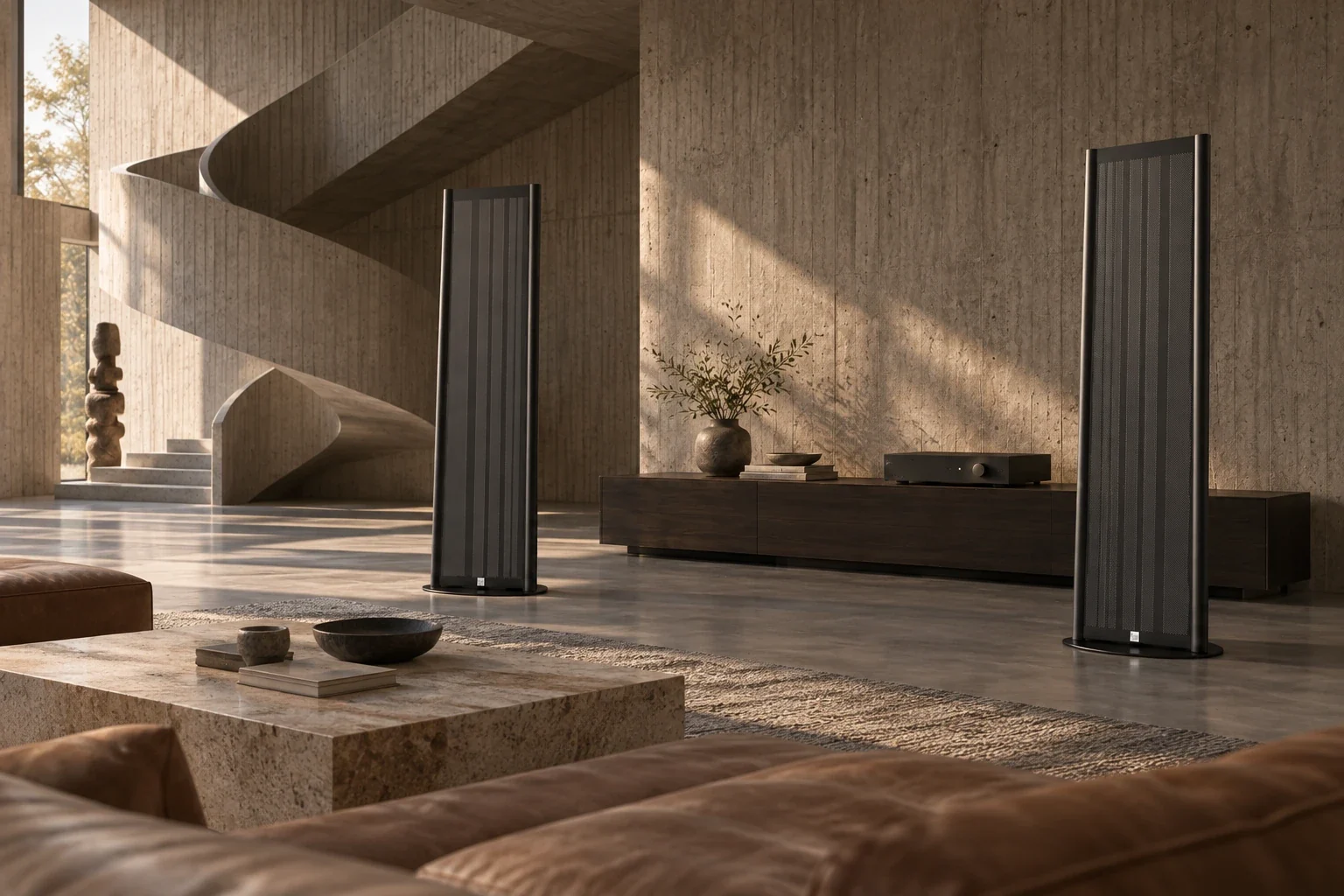
Full range electrostats
Configure
Full range from a single panel. Configured with your own amplifier, or by your dealer.
Final 3200, Final 3300 and Final 3900
Explore Configure
Final. As performed. Nothing added. Nothing lost.
The next step is
a private listening.
Bring a track you know by heart.
Hear what Final brings to it.